
What is a Cancelled Cheque?
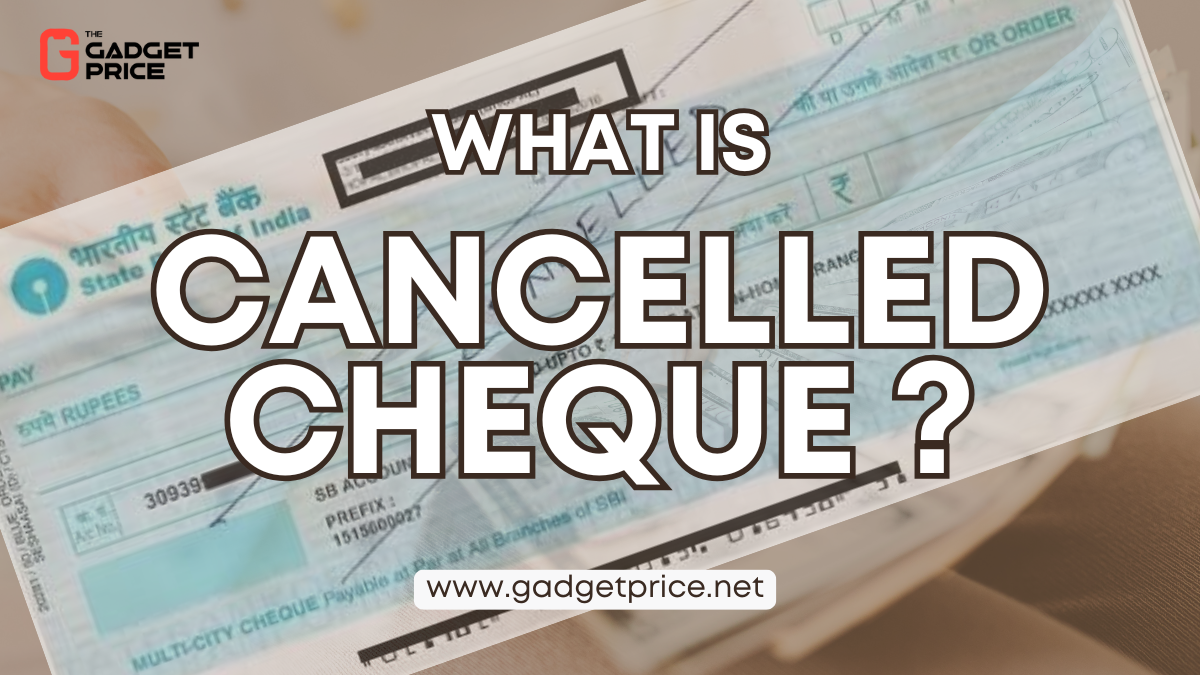
A cancelled cheque is a cheque that has been voided and cannot be used to makeorwithdrawmoney. Abankaccount holder marks a cheque as cancelled by drawing two parallel lines across the face of the cheque and writing the word “CANCELLED” between those lines. Acancelled cheque is an important legal document because it showsverification about the bank account details: account holder name, account number, bank branch, IFSC code, and MICR code. The cancelled cheque is commonly used as proof of ownership of the bank account without the risk of fraud or unauthorized transactions.
Read also : What is EMI: Full Form, Meaning, Calculation, and How it Works
Why Do You Need a Cancelled Cheque?
Cancelled cheques are required for various banking and financial purposes to confirm and verify bank account details securely. Some key reasons include:
- Bank Account Verification: When opening new accounts, applying for loans, or credit cards.
- Setting up Electronic Clearing Services (ECS): For automatic payments like EMIs, bills, or subscriptions.
- Income Tax Refunds: To ensure tax refunds are credited to the correct account.
- Salary Crediting: Employers often require cancelled cheques to directly deposit salaries.
- KYC (Know Your Customer) Compliance: Used as a supporting document during identity verification.
- Investment and Insurance: Required for linking bank accounts with mutual funds, insurance claims, and other investments.
Uses of a Cancelled Cheque
- Serves as proof of ownership of a bank account.
- Helps in setting up and authorizing auto-debit for EMIs, subscriptions, or payments.
- Verifies bank account details for refunds and direct deposits.
- Provides documentation for KYC processes with banks and financial institutions.
- Used in mutual fund and DEMAT account openings.
- Facilitates Insurance premium payments and claim settlements.
- Required during Employee Provident Fund (EPF) withdrawals.
How to Prevent Risk Associated with a Cancelled Cheque
Though cancelled cheques cannot be used for financial transactions, they still contain sensitive banking information. To minimize risks:
- Always write “CANCELLED” clearly and across the cheque in bold letters.
- Avoid signing the cheque when cancelling it.
- Share cancelled cheques only with trusted institutions or parties.
- Do not provide physical or scanned copies unsolicited or to unknown recipients.
- Store cancelled cheques securely to prevent unauthorized copying or misuse.
Read also : How to Check UTI PAN Card Status Online – Step by Step Guide
What Should I Do if a Cancelled Cheque is Lost or Misplaced?
Losing or misplacing a cancelled cheque is not uncommon. If this happens:
- Immediately inform your bank and concerned financial institutions.
- Request a fresh cheque leaf or a cheque book.
- Consider changing your account details if identity theft or fraud is suspected.
- Use alternative documents like bank passbook or bank statement for verification temporarily.
- Always keep digital copies of cancelled cheques securely for re-submission if needed.
Difference Between Stop Payment and Cancelled Cheque
| Aspect | Stop Payment Cheque | Cancelled Cheque |
|---|---|---|
| Purpose | Requests the bank to not honor a particular cheque | Marked to prevent any transaction, used as proof only |
| Usage | For stopping payment on a specific cheque after issue | Non-transactional document for account verification |
| Cheque Status | Valid cheque but payment stopped by bank | Cheque explicitly rendered non-usable |
| Signature Requirement | Signed cheque | Not signed; only “CANCELLED” marked |
| Effect on Account | Payment for that cheque blocked | No effect on account, only provides bank details |
| Re-usability | Cannot be used to withdraw, but remains valid | Cannot be used for any financial transaction |
Read also : Check Your CIBIL Score Free
Conclusion
A cancelled cheque is a simple yet essential document widely used to verify bank account details safely and avoid misuse. Whether applying for loans, setting up EMIs, or completing KYC processes, it plays a crucial role in reducing fraud risks while confirming authentic banking information. Always ensure to cancel the cheque properly and keep it secure to protect sensitive bank data.
A cheque marked with two parallel lines and the word “CANCELLED” written across it so it cannot be used for payments but can be used as bank account proof.
It is used to verify bank account details during loans, EMI setup, salary crediting, tax refunds, and KYC processes.
Draw two parallel lines across the cheque and write “CANCELLED” between the lines in bold without signing it.
While it cannot be used for transactions, sharing it carelessly can expose sensitive bank details, so handle it securely.
Inform your bank, request new cheque leaves, and use alternative documents for verification if needed.
What is the difference between a stop payment and a cancelled cheque?
A stop payment blocks a specific cheque payment but keeps the cheque valid for record, whereas a cancelled cheque is purposely invalidated for any transaction but used for proof.
No, it cannot be used for transactions but can be used for verifying bank account details when linking accounts for fund transfers or payments.